Categories
Preschool Learning

Play-Based Learning vs. Traditional Learning in Preschool
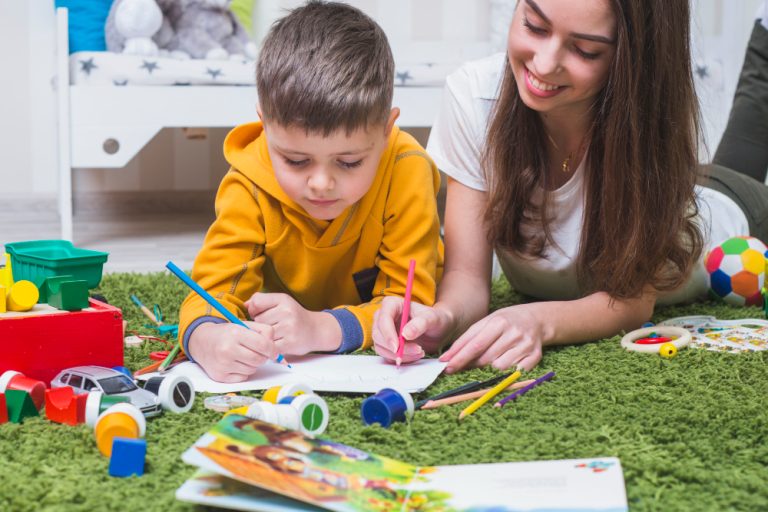
If you’ve toured more than one preschool, you’ve probably noticed that classrooms can feel very different from each other. One school has children sitting at desks with workbooks. Another has children building towers, painting murals, and playing house. Parents often wonder: which approach actually prepares my child better for kindergarten and beyond?

The answer, backed by decades of early childhood research, might surprise you. This guide breaks down both approaches — play-based and traditional — so you can make an informed decision for your child.

What Is Play-Based Learning?

Play-based learning is an educational approach in which children acquire knowledge and develop skills through structured and unstructured play. It doesn’t mean children simply do whatever they want — rather, teachers intentionally design the environment and activities so that play naturally leads to learning outcomes.

In a play-based classroom, children might build a city with blocks (learning geometry and physics), run a pretend grocery store (learning math and social skills), or create a painting inspired by a story (developing literacy and fine motor skills). The learning is real — it’s just embedded in experiences the child finds engaging and meaningful.

What Is Traditional Learning in Preschool?

Traditional preschool approaches lean more toward direct instruction — teacher-led lessons, worksheets, structured academic drills, and measurable academic benchmarks. Children may spend more time at desks or tables and less time in free or guided play.

This approach can produce faster short-term gains in specific academic skills like letter recognition or number writing. However, research raises questions about whether those gains are sustained and whether the approach adequately develops the whole child.

What Does Research Say?

The research is remarkably consistent: play-based learning produces better long-term outcomes for children in preschool and early elementary school. A landmark study published in Science found that children in direct instruction classrooms scored higher on specific academic tests at age 5 — but by age 7, children from play-based environments had caught up academically and significantly outperformed direct-instruction peers in creativity, social skills, emotional regulation, and motivation.

The American Academy of Pediatrics (AAP) formally endorsed play as essential to healthy brain development in 2018, noting that play builds executive function, creativity, language skills, and social-emotional competence — all of which are stronger predictors of long-term success than early academic drilling.

The social skills component is especially significant. We cover how play specifically builds social competence in our post on how preschool helps improve social skills in children ages 2 to 5.

Benefits of Play-Based Learning

  • Builds intrinsic motivation — children learn to love learning
  • Develops executive function skills: planning, flexibility, self-control
  • Strengthens language and communication naturally through interaction
  • Encourages problem-solving and creativity
  • Builds social skills through cooperative and dramatic play
  • Reduces stress and anxiety — learning feels safe and enjoyable
  • Supports gross and fine motor development through physical play

Are There Situations Where Structured Learning Is Better?

Yes. Children who are further behind in specific academic skills — letter recognition, number sense — sometimes benefit from more targeted, direct instruction as a supplement to play-based learning. The most effective preschool programs, including LSA Preschool, blend both: structured, teacher-guided learning moments within a primarily play-based framework.

The key word is ‘supplement.’ Research does not support replacing play with worksheets in preschool. It supports adding intentional learning opportunities within a play-rich environment.

How to Evaluate a Preschool’s Learning Approach

When you visit a preschool, ask to spend time in the classroom. Look for: Are children engaged and curious? Do teachers participate in and guide play? Is there a mix of child-led and teacher-led activities? Our guide on what to look for in a preschool in Deerfield Beach gives you a full evaluation checklist.

LSA Preschool’s Approach: The Best of Both Worlds

At LSA Preschool, we use a research-informed blended approach. Our curriculum provides structured learning in literacy, numeracy, and language development — embedded within a play-rich environment that keeps children engaged, curious, and emotionally regulated. Children develop all the skills listed in our kindergarten readiness guide for 3-year-olds through experiences they genuinely enjoy.

We believe that when children love coming to school, everything else — learning, development, social growth — follows naturally.

Ready to Give Your Child the Best Start?

At LSA Preschool in Deerfield Beach, FL, we are dedicated to nurturing every child’s growth through a loving, stimulating environment. Whether you’re exploring enrollment options or ready to visit our campus, we’d love to meet your family.

Schedule a Tour at LSA Preschool — Let’s find the perfect program for your child.

Explore all our preschool programs and services to find the right fit.

Categories
Preschool Learning

Best Age to Start Preschool in Deerfield Beach, FL

One of the most common questions parents ask us at LSA Preschool is: ‘Is my child ready for preschool?’ It’s a deeply personal decision, and there’s no single answer that fits every family. However, research in early childhood development — and our own experience working with hundreds of families in Deerfield Beach — gives us clear insight into the ideal age range and the signs of readiness that matter most.

This guide walks you through everything you need to know about preschool starting age, so you can make a confident, informed choice for your child.

What Age Do Most Children Start Preschool?

Most preschool programs in Florida and across the United States accept children between the ages of 2.5 and 5. The most common entry points are age 3 (for a 3-year-old preschool program) and age 4 (for a pre-K program). Some programs, including LSA Preschool, also offer toddler programs starting at age 2.

Florida’s Voluntary Pre-Kindergarten (VPK) program is available to all children who turn 4 by September 1st of the enrollment year. This state-funded program is an excellent option for families in Deerfield Beach, and LSA Preschool is a licensed VPK provider.

Why Starting Between Ages 2.5 and 3 Is Often Ideal

Research published by the National Institute for Early Education Research (NIEER) consistently shows that children who begin quality preschool programs between ages 2.5 and 3 demonstrate stronger language development, better social skills, and improved school readiness compared to children who start at age 4 or 5. The brain is at its most adaptable during these early years — learning happens faster and more naturally than at any other time in life.

The social benefits alone make early enrollment worthwhile. We explore this in detail in our guide on how preschool helps improve social skills in children ages 2 to 5.

Signs Your Child Is Ready for Preschool

Language and Communication

  • Uses simple sentences to express needs and feelings
  • Understands and follows 2-step directions
  • Can say their own name and recognize family members’ names

Self-Care Basics

  • Can eat independently (finger foods, spoon use)
  • Is working toward or has achieved basic toilet training
  • Can put on and remove simple clothing items

Social and Emotional

  • Shows interest in other children
  • Can handle brief separations from parents without prolonged distress
  • Demonstrates curiosity about the world around them

Not every child will check every box at the same time — and that’s perfectly normal. Preschool is designed to help children develop these skills in a structured, supportive environment. If your child is working on a few of these areas, that’s exactly what preschool is for.

What If My Child Isn’t Toilet Trained Yet?

Many parents worry that their child must be fully toilet trained before starting preschool. At LSA Preschool, we work with families during the toilet training process. Children in our toddler programs (age 2–3) are not required to be fully trained. We have dedicated changing facilities and supportive staff who assist with this developmental milestone.

By age 3, most children should be actively working on toilet training, and our structured daily schedule naturally supports this routine.

Is Starting Preschool Later a Problem?

Some parents prefer to wait until age 4 or 5. This is a valid choice, especially if a child is not yet emotionally or developmentally ready. However, research does suggest that children who start later may miss the critical window for certain social and language development milestones that are most easily acquired in a structured peer environment between ages 2 and 4.

If you’re thinking about what your child should know before they enter kindergarten, our guide on what a 3-year-old should learn before kindergarten provides a useful benchmark.

The Deerfield Beach Preschool Landscape

Deerfield Beach and South Broward County offer several preschool options, ranging from faith-based programs to Montessori schools to standard developmental preschools. When choosing, look beyond price — consider the curriculum approach, staff-to-child ratios, teacher qualifications, facility safety, and the school’s philosophy on child development.

For a full list of what to evaluate when choosing a preschool, see our guide on top things to look for in a preschool in Deerfield Beach.

How LSA Preschool Supports Children at Every Starting Age

At LSA Preschool, we offer age-appropriate programs for children from age 2 through VPK. Our curriculum blends structured learning with play-based exploration, and our experienced educators are trained in early childhood development. Every child is met where they are developmentally — and supported in growing from there.

Learn about the benefits of our play-based approach in our post on play-based learning vs. traditional learning in preschool.

Ready to Find Out If Your Child Is Ready?

The best way to know if your child is ready for preschool is to schedule a visit and let our educators meet your child in person. We’ve welcomed hundreds of families in Deerfield Beach and can help you determine the right program and starting point for your little one.

Ready to Give Your Child the Best Start?

At LSA Preschool in Deerfield Beach, FL, we are dedicated to nurturing every child’s growth through a loving, stimulating environment. Whether you’re exploring enrollment options or ready to visit our campus, we’d love to meet your family.

Schedule a Tour at LSA Preschool — Let’s find the perfect program for your child.

Explore all our preschool programs and services to find the right fit.